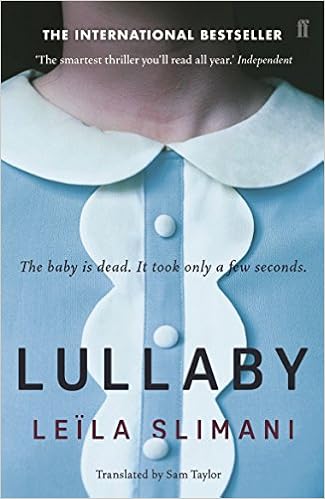
BBC World Service are doing a programme in their World Books series on this Prix Goncourt winning title. I’ve submitted a question and hope to be there for the session with the author later this month.
Slimani is a no-prisoners author and personality in the grown up literary world of French writers and this book cemented her position in the pantheon. With good reason. I was fretting about developing a thriller fever which would stop me appreciating ‘real’ writing, but there are more ways to hook you into a text than the atavistic hunger for what next? There’s also why in God’s name?
Myriam and Paul Masse find Louise to be the perfect nanny, gently insinuating her competence into their fractious efforts at parenting their two young children. We learn about all of this after the chilling opening – that the two children have been killed by the nanny. Slimani wanted to write about the complex power relations at work when wealthy middle class parents let outsiders take the hard work out of raising their kids so that the mother can fulfill her desire to have agency in the world of work. The author seized on the real life story of a nanny who slaughtered her charges, and invested it with a bravura performance of psychological insight and racial/economic/political analysis that is masterly.
The style is taut, pitiless, beautiful. It reminded me of Camus in its inflexionless, unflinching simplicity of style. Its inquisitive energy also reminded me of Rachel Cusk’s elegant narrative technique. You know what’s happened, but that doesn’t stop you lapping up every page of the short novel, sharing with the author in the discovery of who these complex, muddlesome, tricky folk are.
Slimani is Moroccan/French and the mother, a successful lawyer living in the 10th Arondissement with her music producer husband, shares that background, though this is only mildly sketched in. The nanny is white, oppressed by an abusive dead husband and shunned by her delinquent daughter, living in a horrible studio flat in an area that’s largely taken over by immigrants. Her employers gradually come to loathe her porcelain complexion and her mincing Peter Pan collars. (I told you they were tricky folk). My question is about whether there’s anything problematic in these tropes now that it’s become commonplace to berate authors who write about any ethnicity that isn’t squarely their own. It’s a subject close to my heart, given my close connection to Pakistani culture. Let’s see if there’s any appetite for this discussion.
 Izzy Brown