
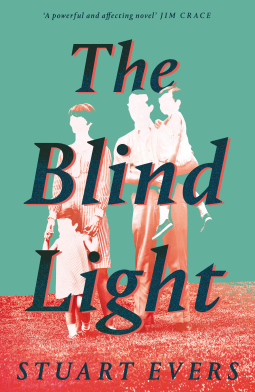
Picador are positioning this Gen Adult/Literary Fiction title on 1 June as a heavy-hitting state-of-the-nation novel in the vein of Don de Lillo and I can see why. Evers is an accomplished author and every page is finely-wrought, full of carefully-observed, arresting prose, and polished, effective dialogue.
I struggled with it, though. The allusive present-day opening is quite confusing, even for a pretty sophisticated reader of literary fiction like me. We’re quickly transported back to the late ’50s and Doom Town, and we easily respond to the shift in mood and the masculine texture of Drum’s Cold War army life. For me, the story starts to really come to life with Gwen and her lovely, textured relationship with Nick, the ageing poet and his daily pint of black and tan. Evers has many colours in his palette of social classes and family relationships, and this is what really kept me reading. I also loved his compact, powerful descriptive technique. You could see and smell ‘the plum and milk sofa’ with its antimacassars; the room that smelt ‘of lilac and baking’; the ‘peach sherbet carpeting’. I was swept into the world of 1990s Raves and the fierce transactions between gay and heterosexual couples, the writing had a very forceful energy here. The complexity of the class dynamics between Drum and Gwen and his officer-class chum/mentor/antagonist Carter and his wife Daphne is finely-crafted and works well, bringing to a successful, if slightly melodramatic conclusion, the seeds of betrayal that have been sewn through the decades, generation to generation.
What didn’t quite work for me, though, was the important thread of existential doom that is meant to be hanging over both families, as it was throughout the Cold War, right up to the unlikely arrival of Gorbachev on the scene. We do need reminding that the threat of nuclear annihilation was very real right up to the early ’90s, but there is something a little preachy about the place this holds in the narrative. There is a key set-piece climax, based entirely on what happens when the two families are forced into close proximity against the threat of nuclear disaster, which sends the two families into another level of dismay and which, for me, felt forced. It almost felt, to me, as though the book would have worked just as well if it simply focussed on the seemingly random choices that the characters, like all of us, make in life, and how they shape our lives for better or worse. Evers has his main characters ponder this at regular intervals, and writes brilliantly about this.
There’s something very weighty (in a good way) about Evers’ work, and the characters and their world stay with you long after you finish reading the book. I’m thankful to NetGalley and Picador for a chance to read it now.
 Izzy Brown